
Digital marketing gives organizations access to an enormous amount of data. Marketers can measure impressions, clicks, website visits, engagement, conversions, bounce rates, email opens, and dozens of other metrics. However, having access to more data does not necessarily lead to better decisions. The real challenge is determining which measurements actually matter to the organization.
This is where key performance indicators (KPIs) become important. KPIs allow marketers to focus on measurements that demonstrate progress toward specific business and marketing goals. Rather than reporting every available metric, organizations should identify the indicators that provide meaningful information about performance and can help guide future decisions.
Connecting KPIs to Business Goals
One of the most important principles when selecting KPIs is alignment with organizational goals. According to Jackson (2016), KPIs should connect measurement with the objectives an organization is trying to accomplish. Without this connection, marketers may spend too much time analyzing numbers that look impressive but provide little information about actual business performance.
For example, imagine a company launches a social media campaign with the primary goal of increasing brand awareness. In this situation, reach, impressions, and brand mentions could be appropriate KPIs because they indicate how many people are being exposed to the brand. If the company’s goal is instead to generate qualified leads, impressions alone would not provide enough information. Metrics such as click-through rate (CTR), landing-page conversion rate, cost per lead, and qualified leads would provide a much stronger indication of whether the campaign is accomplishing its objective.
This distinction is especially important because marketers have access to so many possible measurements. Meltwater (2026) notes that organizations should select social media KPIs based on the business outcome they are trying to achieve rather than using the same measurements for every campaign. For example, awareness campaigns can emphasize reach and impressions, while lead-generation campaigns should focus more heavily on conversion-related metrics.
Using the REAN Model
One useful approach for organizing KPIs is the REAN model, which divides the customer journey into four areas: reach, engage, activate, and nurture (Jackson, 2016). Each stage can be associated with different KPIs depending on what the organization wants customers to do.
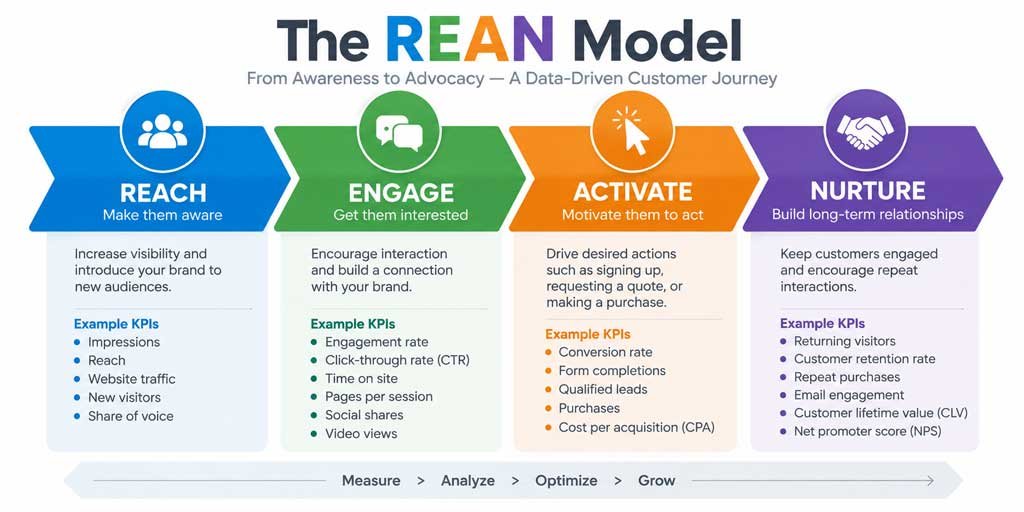
Figure 1. The REAN model and examples of KPIs across the customer journey.
In the reach stage, a company is trying to increase visibility among potential customers. Appropriate KPIs might include impressions, reach, website traffic, or new visitors. During the engage stage, marketers want to understand whether people are interacting with the brand. KPIs might include engagement rate, time spent on a page, content shares, or CTR.
The activate stage focuses more directly on encouraging customers to take a desired action. Depending on the campaign, conversion rate, completed forms, purchases, or qualified leads could serve as KPIs. Finally, the nurture stage focuses on maintaining customer relationships. Returning visitors, repeat purchases, email engagement, retention, and customer lifetime value can help organizations evaluate whether they are successfully developing long-term relationships.
Turning Data Into Decisions
KPIs are valuable not only because they measure performance, but also because they help marketers decide what to do next. For example, a paid digital advertising campaign may generate a large number of impressions but have a low CTR. This could indicate that the campaign is reaching people but the creative, message, offer, or audience targeting is not motivating them to take the next step. Marketers could then test different headlines, visuals, calls to action, or audience segments and compare the results.
Similarly, analyzing referral traffic can reveal which external sources are sending meaningful visitors to a website. Comparing new and returning visitors can also provide insight into whether content is attracting new audiences while continuing to engage existing ones (DeMers, 2025). These measurements become especially useful when marketers compare performance over time or against appropriate benchmarks.
Ultimately, effective digital analytics is not about measuring everything. It is about measuring the right things. When KPIs are clearly connected to business goals, marketers can move beyond simply reporting numbers and begin using data to explain performance, improve campaigns, allocate resources more effectively, and support better business decisions.
References
DeMers, J. (2025). 50 content marketing metrics to measure your campaign. Meltwater.
Jackson, S. (2016). Cult of analytics: Driving online marketing strategies using web analytics (2nd ed.). Routledge.
Meltwater. (2026). Social media metrics and KPIs: What to measure in 2026. Meltwater.
Leave a Reply
You must be logged in to post a comment.